Pages

Showing posts with label 2001 a space odyssey. Show all posts

Tuesday, September 6, 2011

2011: An Inner Space Odyssey

Stanley Kubrick's 2001: A Space Odyssey is a slow and masterful telling of man's ascent from primitive ape-man to space-faring astronaut, and eventually to cosmic being. The movie is unusual in that not a word is spoken for the first 25 mins, as the director instead focuses his attention on the grunts of the early human hominids and the glorious strings of Johann Strauss.  It is no surprise then, that the movie should induce an almost meditative state in the viewer, as they wait between long bouts of quietude for any hint of action or dialogue. An important part of the practice of meditation is the ability to focus on one's breath. In 2001, the audience is subjected to the sound of Dave Bowman's breathing (and nothing else) for several minutes, as he ventures outside of the spacecraft to replace a faulty unit.

If I am correct in my assertion that 2001 is an attempt to make a movie capable of putting its audience in a trance-like state, then presumably the story-line should reflect this.

2001: A Space Odyssey is about a manned mission to the planet Jupiter that goes awry when the ship's on board computer starts killing of its crew members. As the sole surviving member of the ship, Bowman must re-enter the spaceship and deactivate the computer: HAL 9000. What follows is probably one of the most moving scenes in the entire film, in which Bowman removes each of Hal's memory cassettes one by one, effectively killing him. From a transcendental meditation point of view this is the equivalent to dismantling of the ego. Once Bowman has accomplished this unpleasant task he is free to go on his epic journey of self-discovery (through the monolith) and arrive safely at the centre of the Universe.

From this perspective, Kubrick seems to be suggesting that without dismantling the ego - whose possessive nature is touted as being the cause of all mankind's wars and woes - humanity will never be able to progress to that transcendental state, which to quote Bowman himself is "full of stars". The defective nature of the ego is embodied in the concept of the thinking computer, which is well known to be incapable of processing two conflicting pieces of information at the same time. HAL developes his homicidal tendencies in response to just such a conflict arising between his programming, which tells him not to lie, and his orders, telling him to conceal the truth. Kubrick appears to be saying that in order for humanity to evolve and survive its war-like nature, mankind must get beyond the black and white thinking of rationality and morality towards a more dualistic state of being, and possibly a more open and inclusive society.

This change must occur on an individual and internal basis, as much as on the societal level, although it is still too early to predict if Kubrick was correct that this change would come in the 21 Century.

For those amonst you who resist the idea of dismantling the ego, as it might imply a total character assassination, let me remind you that in the sequel 2010: A Space Odysssey, HAL is resurrected as a cosmic being to help Bowman in his role as ambassador of Earth. The ego, like the self, never really dies it just becomes transformed, and as it does so, it is said to dispense with its violent and dominating nature to assist in the total being.

That time is now, potentially, at hand.

Sunday, December 26, 2010

PRIMA MONOLITHICA

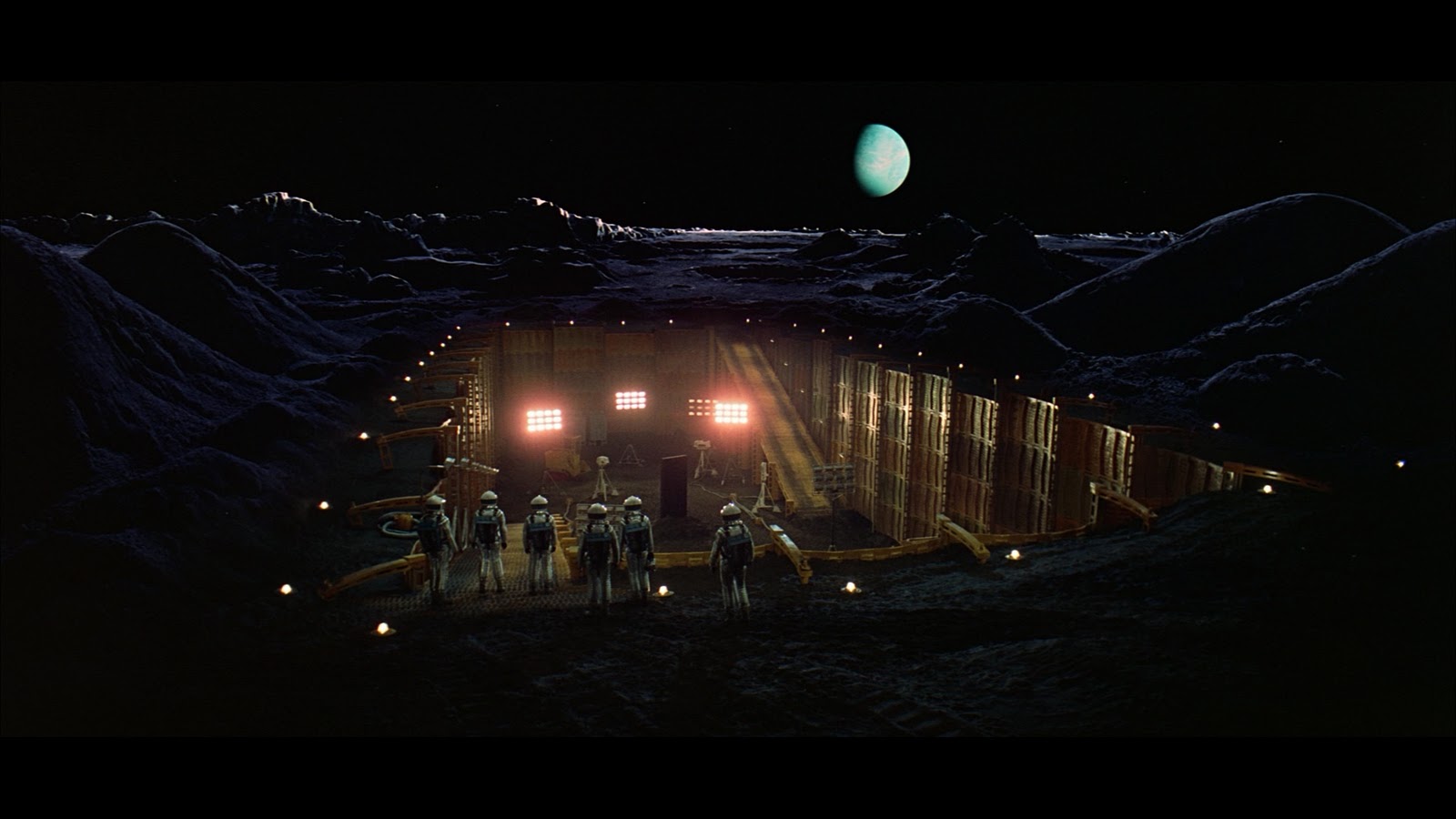
Stanley Kubric's 2001; A Space Odyssey is the tale of mankind's ascent to the stars, and their eventual encounter with a mysterious alien intelligence. The film opens with a group of proto-humans scavenging on the African plains. All of a sudden, a black monolith appears and gives them instruction on how to hunt and coordinate defensive strategies. The next time we see the monolith, it is being excavated by a group of astronauts on the moon. The planets form an auspicious conjunction, and the monolith broadcasts a signal into outer space; somewhere in the vicinity of Jupiter. A mission is hastily assembled to go out and investigate.


I believe that the chief motivation behind the making of this movie is not to ground a space adventure in classical mythology, but to produce a allegory for the pursuit of the Great Work/Alchemy. People often mistakenly assume that alchemy is about transforming lead into gold, but this isn't strictly the case;

If alchemy isn't gold making, what is it? Wilmshurst has defined ~ it as 'the exact science of the regeneration of the human soul from, its present sense-immersed state into the perfection and nobility of ~ that divine condition in which it was originally created'. However, he immediately goes on to offer a second definition which clearly implies that, as with gold making, soul-making is again only a specific case. By inference, a general theory of alchemy might be ventured. Alchemy is a total science of energy transformation.


"A total science of energy transformation." This statement is very relevant in terms of the nature of the ideas expressed in Kubrick's 2001; A Space Odyssey, because the aliens responsible for building the inter-dimensional monolith eventually superceded this technology by transforming their physical forms into pure energy. We know this because of the famous scene at the end of 2001;A Space Odyssey were the astronaut Bowman is seen floating in space as a foetus; having just been reborn as an energy being. The benefits for space travel attained by becoming an energy being are apparent; for instance one would no longer have any need for life-support systems, having satisfactorily achieved the status of Gods. In Kubrick's 2001, the method of physical transformation is the monolith, while in alchemy the method transformation is achieved through the Philosopher's Stone. 

One of the primary works of modern alchemy is Fulcanelli's La Mystere des Cathedrales. In it he extensively details all the religious iconography of relevance to alchemy that exist in the gothic cathedral's of Europe. One such example is of the Black Madonnas; a series of small statuettes carved of either a black material or painted that way, which invariably remain hidden in the vaults underneath the main cathedrals. It was due to the surreptitious nature of the Black Madonna's, as well as their unusual colour, which lead Fulcanelli to suppose they may be representative of the alchemist's prima materia, the first matter of the alchemist's Philosopher's Stone.

 The esoteric meaning of our black Virgins cannot better be defined. 
They represent in hermetic symbolism the virgin earth, which the 
artist must choose as the subject of his Great Work. It is first matter 
in mineral state, as it comes out of the ore-bearing strata, deeply 
buried under the rocky mass. It is, the texts tells us, 'a heavy, brittle, 
friable black substance, which has the appearance of a stone and, 
like a stone, can shatter into minute fragments.' Thus it appears to 
be the rule that the personified hieroglyph of this mineral possesses 
its special colour and that the subterranean parts of temples are 
reserved as its dwelling place. 
In 2001; A Space Odyssey, the black monolith is seen at the bottom of an excavation trench on the surface of the moon. As such it is analogous to the prima materia of the alchemist, as described in the above excerpt. La Mystere de Cathedrales contains another description of how to obtain the elusive material, which is revealing;

 'Take some real earth... well impregnated with
the rays of the sun, the moon and the other stars.'

This instantly suggests to me a meteor of some kind–– a space rock of extraterrestrial origin, just like the monolith. Incidentally, the Islamists worship a black meteor located at the Kaaba, in Mecca. The Kaaba is Arabic for cube and, as we saw in previous posts, Saturn is both associated with the cube and the colour black, suggesting an inter-dimensional gateway of some kind; See Gateway Solid.